As an Amazon Associate, we earn from qualifying purchases. Some links on this site are affiliate links at no extra cost to you. Our recommendations are based on thorough research and editorial judgment.


Humidifiers For Dry Winter Air: How To Use

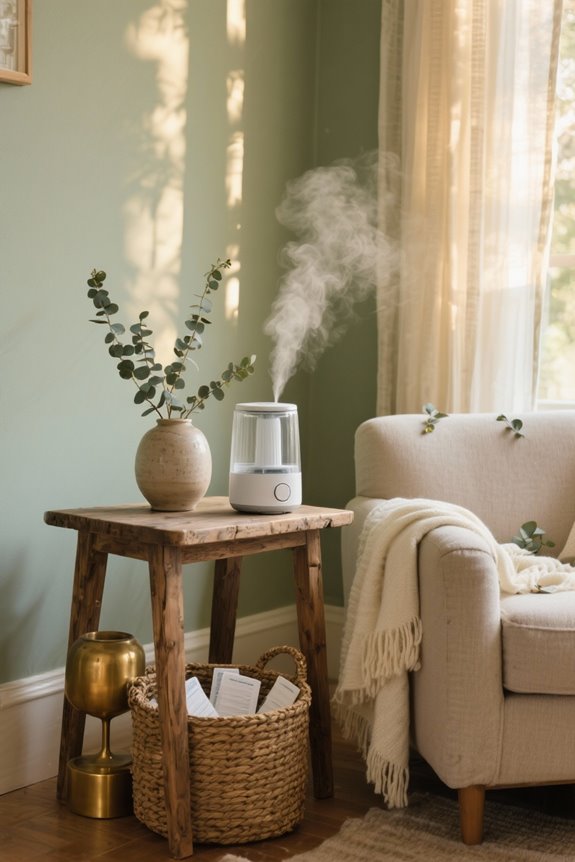
Humidifiers are effective for combating dry winter air by adding moisture to indoor spaces. To use them properly, choose the right type for your needs, such as ultrasonic for quiet operation or evaporative for self-regulation. Measure your room size to guarantee adequate coverage, typically 0.5 to 2.5 gallons daily, depending on the space. Place the humidifier in a central location, monitor humidity levels, and maintain cleanliness to avoid issues. Understanding these principles can enhance your humidifier experience and provide peak comfort.
Key Takeaways
- Choose an ultrasonic humidifier for quiet operation and low maintenance, ideal for use in bedrooms during dry winter months.
- Measure your room size to select a humidifier with appropriate coverage, aiming for 1.5 to 2.5 gallons daily for medium rooms.
- Place the humidifier at least 2 feet above the floor and 3 feet away from occupants to ensure even moisture distribution and comfort.
- Maintain indoor humidity levels between 30% and 40% in winter to prevent respiratory issues and protect furniture from damage.
- Regularly clean the humidifier every three days with vinegar to remove mineral buildup and follow the manufacturer’s instructions for filter replacement.
Choosing the Right Type of Humidifier
You may be interested

Selecting the right type of humidifier can greatly enhance the comfort of a living space during dry winter months. Two main types to examine are ultrasonic and evaporative models.
Ultrasonic humidifiers offer notable benefits, including:
- Quiet operation, making them ideal for bedrooms
- Low energy consumption, reducing utility costs
- No hot surfaces, minimizing burn risks
However, they may generate mineral dust if hard water is used, necessitating the use of distilled water.
On the other hand, evaporative humidifiers present certain limitations. While they are self-regulating to avoid over-humidification, they can be noisy due to the fan. Additionally, ongoing maintenance is required, including filter replacements to guarantee peak performance and hygiene. Consequently, understanding these differences aids in selecting the perfect humidifier for winter comfort. Moreover, the choice between ultrasonic and evaporative models can significantly impact effectiveness and user experience.
Recommended Products

𝙁𝙖𝙨𝙩 𝙃𝙪𝙢𝙞𝙙𝙞𝙛𝙞𝙘𝙖𝙩𝙞𝙤𝙣 𝘼𝙡𝙡 𝙉𝙞𝙜𝙝𝙩: Runs for up to 25 hours on low thanks to its SUPER LARGE capacity of 2.5 liters. The soothing moisture helps quickly relief congestion and dry throat.

𝙁𝙖𝙨𝙩 𝙃𝙪𝙢𝙞𝙙𝙞𝙛𝙞𝙘𝙖𝙩𝙞𝙤𝙣 𝘼𝙡𝙡 𝙉𝙞𝙜𝙝𝙩: Runs for up to 25 hours on low thanks to its SUPER LARGE capacity of 2.5 liters. The soothing moisture helps quickly relief congestion and dry throat.

𝐅𝐨𝐫𝐠𝐞𝐭 𝐚𝐛𝐨𝐮𝐭 𝐜𝐨𝐧𝐬𝐭𝐚𝐧𝐭 𝐫𝐞𝐟𝐢𝐥𝐥𝐬: With a 3L tank and convenient top-fill design, this humidifier large room for baby offers up to 30 hours of long run time humidification in sleep mode, ensuring dry air is no longer an issue for your family, plants, and baby.
Understanding Room Coverage and Size Recommendations

Understanding how to match a humidifier to the size of a room is essential for achieving ideal comfort during dry winter months. Accurate room measurement, typically done by multiplying width by depth, helps in selecting the appropriate unit. Humidifiers are generally categorized by their coverage area:
- Small rooms (up to 300 sq ft): require outputs of 0.5 to 1.5 gallons per day.
- Medium rooms (300 to 600 sq ft): need 1.5 to 2.5 gallons daily.
- Large rooms (above 600 sq ft): may need three or more gallons daily.
Additionally, factors like insulation and room volume can influence the humidifier’s effectiveness. Matching the right humidifier size and output guarantees ideal humidity levels, creating a more comfortable indoor environment. Ensuring that the coverage area matches the room size is crucial for optimal moisture distribution.
Recommended Products

[𝗟𝗮𝗿𝗴𝗲 𝗖𝗮𝗽𝗮𝗰𝗶𝘁𝘆 & 𝗟𝗲𝗮𝗸𝗮𝗴𝗲 & 𝗧𝗼𝗽 𝗙𝗶𝗹𝗹𝗶𝗻𝗴 𝗗𝗲𝘀𝗶𝗴𝗻] Our humidifier boasts a removable 8L (2.1Gal) large capacity tank, featuring a top-filling design that eliminates leakage issues and simplifies the refilling process. With a single refill, it can continuously run for up to 48 hrs. The high moisture output of 300mL/h is designed to humidify an area of up to 800 sq.ft, the best choice for whole-house humidification, suitable for home, dorms, and living rooms.

𝟰𝗟 𝗟𝗮𝗿𝗴𝗲 𝗧𝗮𝗻𝗸 𝗳𝗼𝗿 𝗖𝗼𝗻𝘁𝗶𝗻𝘂𝗼𝘂𝘀 𝗖𝗼𝗺𝗳𝗼𝗿𝘁: Enjoy quiet sleep without congestion, coughing, or dry mouth, DREO baby humidifier's ultrasonic atomization brings noise down to 28dB, while its 4L tank provides up to 36 hours of moisture without the need to refill.

𝐅𝐨𝐫𝐠𝐞𝐭 𝐚𝐛𝐨𝐮𝐭 𝐜𝐨𝐧𝐬𝐭𝐚𝐧𝐭 𝐫𝐞𝐟𝐢𝐥𝐥𝐬: With a 3L tank and convenient top-fill design, this humidifier large room for baby offers up to 30 hours of long run time humidification in sleep mode, ensuring dry air is no longer an issue for your family, plants, and baby.
Optimal Placement for Maximum Effectiveness

Placing a humidifier correctly can greatly enhance its performance and effectiveness. Ideal placement strategies include:
- Elevated Positioning: Humidifiers should be at least 2 feet above the floor. This allows mist to rise and circulate effectively throughout the room.
- Central Location: Positioning the humidifier near the center of the room promotes even moisture regulation. Avoid corners or lying it too close to walls.
- Distance from Occupants: Maintain at least a 3-foot distance from sitting or sleeping areas. This prevents direct mist exposure, which may lead to discomfort.
- Safety Considerations: Keep humidifiers out of reach of children and pets, using protective bases to prevent water damage. Additionally, ensuring an adequate water level can help maintain optimal moisture output for improved air quality.
Operating Instructions for Best Results

To achieve the best results from a humidifier, careful attention to operating instructions is vital. Users should monitor indoor humidity levels, ideally maintaining them between 30% and 50%. A hygrometer can help guarantee accurate readings, enhancing operating efficiency.
Additionally, rather than running the humidifier continuously, it is advisable to operate it only when necessary. This prevents over-humidifying the air and discourages microbial growth.
For peak performance, it is essential to use distilled or demineralized water, as tap water may introduce unwanted particles. Regular maintenance is vital for preventing mineral buildup, ensuring the durability and effectiveness of your humidifier.
Lastly, following the user manual closely allows for proper setup and safe operation, confirming all guidelines are met for effective use. Regularly check and replace any filters as specified to maintain overall function and cleanliness.
Maintenance and Cleaning Practices

Effective maintenance and cleaning practices play a significant role in ensuring the longevity and functionality of humidifiers.
Daily Upkeep:
- Unplug the humidifier before cleaning to avoid electrical hazards.
- Empty and replace the water daily to prevent bacteria growth.
- Rinse and dry the tank and base each day to minimize moisture buildup.
- Wipe down the exterior regularly to remove dust.
Deep Cleaning:
- Clean every three days during heavy use; otherwise, weekly suffices.
- Use distilled white vinegar to dissolve mineral deposits.
- For tougher scale, consider 3% hydrogen peroxide or 10% bleach solutions, ensuring thorough rinsing for chemical safety.
- Regular cleaning is crucial for preventing bacterial growth and ensuring optimal performance.
Filter Maintenance:
– Inspect and replace filters monthly, following manufacturer instructions.
Health Benefits of Using Humidifiers
Using humidifiers during the dry winter months can yield numerous health benefits, particularly for respiratory health and skin hydration.
Respiratory Health:
- Humidifiers add moisture, soothing dry nasal passages and throat irritation.
- Increased humidity aids in mucus thinning, making coughs more productive and clearing airways.
- Maintaining humidity can reduce airway inflammation, lowering asthma and allergy flare-ups.
Skin Hydration:
- Moist air helps alleviate dry skin, lips, and prevent cracked surfaces.
- Proper humidity supports nasal health, reducing nosebleeds from dry nasal membranes.
Overall Wellness:
- Humidified air may lower the risk of illnesses related to upper respiratory infections.
- It supports mucous membranes, helping enhance natural immunity against pathogens. Additionally, using a humidifier can help reduce allergens and dust in the air, promoting a healthier living environment.
These benefits illustrate the importance of maintaining humidity in winter.
Comfort Improvements With Humidified Air
Humidified air plays a significant role in enhancing indoor atmosphere. Some key benefits include:
- Improved Sleep Quality: Maintaining humidity around 40-50% aids sleep comfort by keeping nasal passages moist, reducing snoring, and lowering nighttime disruptions.
- Enhanced Respiratory Comfort: Moist air alleviates dryness in the eyes, nose, and throat, promoting mucosal health and lowering irritation.
- Preservation of Indoor Environment: Balanced humidity helps prevent damage to wood furnishings and reduces static electricity, contributing to a more comfortable space.
- Perceived Warmth: Humidified air can create a warmer feeling indoors without raising the thermostat, leading to comfort enhancement while potentially saving energy. Additionally, using a humidifier with Germ-Free Technology can further improve air quality by eliminating harmful germs and bacteria.
Safety Features to Look For
A comfortable indoor environment during the winter months benefits greatly from the use of humidifiers. When selecting a humidifier, consider key safety features that enhance microbial resistance and support water sterilization. Effective options include:
- Mold-inhibiting materials: Look for units made from nonporous plastics or with antibacterial coatings to prevent microbial growth.
- Built-in UV sterilization: Some models use UV-C light to kill harmful bacteria and viruses in the water.
- Automatic shutoff: This feature guarantees the device turns off when water is low, preventing overheating.
- Dishwasher-safe components: These allow for easy cleaning, essential for maintaining cleanliness.
Always check for certifications, such as UL or ETL, to verify safety and reliability in operation. Additionally, consider models with smart controls that help maintain optimal humidity levels for comfort and health.
Recommended Products

TOP-FILL LARGE TANK: Easy top-fill design with a spacious 1.5-gallon water tank, delivers 90-hours of runtime on cool mist/low speed, this humidifier is perfect for medium to large rooms. A great choice for anyone searching for a top-fill humidifier with long run time.

WHISPER QUIET ON LOW: Near-silent on the lowest setting for bedside and nursery use. 3 speed settings let you increase output during the day and keep noise low while you sleep

Visible Cool Mist: Ultrasonic membrane converts water into a fine mist that is dispersed evenly into the air; Clean reminder lets you know when to clean the ultrasonic membrane so your humidifier works like new
Energy Considerations When Using a Humidifier
While maintaining a comfortable indoor humidity level during winter, energy considerations become essential for efficient operation and cost management. Different humidifier types vary considerably in energy consumption.
- Ultrasonic humidifiers: 20-35 watts, costing about $2-4 monthly for 8 hours of use.
- Evaporative humidifiers: 30-60 watts, with monthly costs around $3-6.
- Warm mist humidifiers: 250-500 watts, leading to costs of $15-30 monthly.
Despite these differences, humidifiers represent only about 0.11% of total household electricity consumption. Utilizing an ultrasonic model can provide cost savings and reduced energy use, averaging about 30.4 kWh per year. By choosing more efficient models and operating them wisely, users can effectively lower both energy consumption and costs associated with humidifiers. Many users also report that improved sleep quality can be an unexpected benefit of maintaining ideal humidity levels.
The Importance of Humidity Levels
Maintaining proper humidity levels in homes is vital, especially during the dry winter months. The ideal indoor humidity should range between 30% and 50%, with winter levels recommended at 30% to 40% to avoid condensation. Proper humidity contributes to indoor comfort and health by reducing respiratory infections and preventing dry skin. This range also helps protect wood furnishings and instruments from damage. Conversely, low humidity can lead to dry air issues, such as static electricity, sore throats, and increased flu susceptibility. Utilizing tools like hygrometers can assist in monitoring these levels. To summarize, managing humidity levels is essential for well-being and home maintenance in winter conditions, leading to a more comfortable living environment.
Tips for Using Essential Oils With Humidifiers
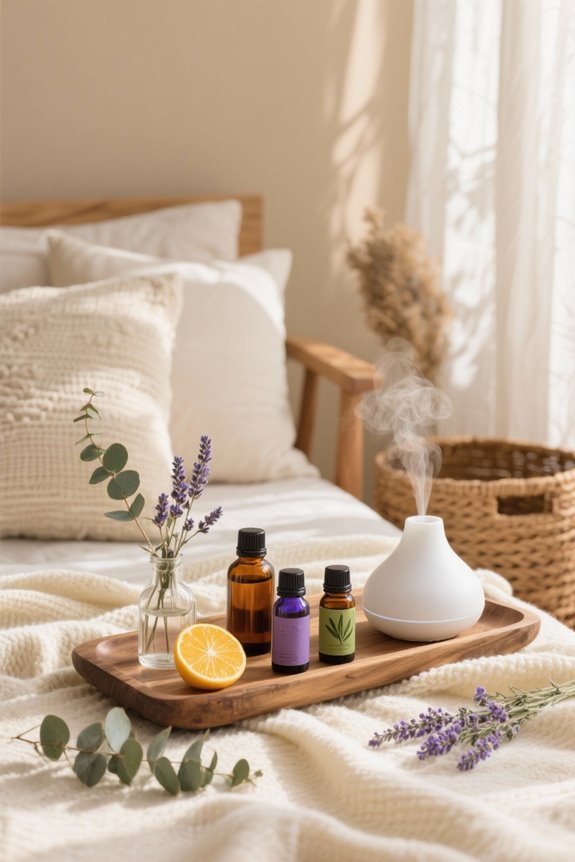
When using essential oils with humidifiers, several guidelines can help enhance the experience. First, choose the right humidifier. Ultrasonic humidifiers and those specifically designed for essential oils are suitable options. Always check the user manual for compatibility.
Next, consider using a diffuser pad, if available, for safe oil diffusion. Start with a few drops of essential oil to find the right balance. Select compatible oils like lavender or eucalyptus, known for their benefits, including relaxation and respiratory relief.
Mix essential oil blends carefully, ensuring that the combination does not overwhelm the senses. Finally, alternating oils can keep the experience fresh, providing various therapeutic effects throughout the winter. Regular cleaning of the humidifier is essential for maintaining its functionality. Moreover, it’s important to select a humidifier with high mist output to effectively improve air quality.
Recommended Products

[3-in-1 Humidifier Meets All You Expect] Cool Mist Humidifier+Aromatherapy+Mood Light, purchase for once to satisfy all you expect! Let Homvana H101 be the best companion in your bedroom.

5-IN-1 AROMATHERAPY DEVICE: This ultrasonic essential oil diffuser is an amazing multi-functional aromatherapy device unlike any other you've ever used. It features a large and easy to clean 500ml water tank, 7 LED light colors, multiple mist nebulizer modes and remote control, as well as a safety auto-switch that prevents it from overheating in case it runs out of water.

Compact and Versatile - Our small oil diffuser is designed to be compact and versatile, making it suitable for various spaces and lifestyles. Aromatherapy diffusers sleek and portable design allows you to easily move it from room to room, enabling you to enjoy aromatherapy wherever you go. Whether you want to create a soothing ambiance in your bedroom, living room, office, or even during travel, an aroma diffuser is a nice choice.
Signs You Need a Humidifier
Identifying the signs that indicate a need for a humidifier can markedly enhance comfort during dry winter months. There are several key signs to check:
- Respiratory Symptoms: Frequent nosebleeds, chronic coughs, and increased sinus issues often indicate low humidity.
- Skin Discomfort: Dry, itchy skin, cracked lips, and even eye irritation can signal a lack of moisture.
- Sleep Quality: Difficulty sleeping due to dry nasal passages or throats suggests insufficient humidity levels.
- Home Environment: Static electricity, warped wood, and dry houseplants are clear humidity indicators.
Troubleshooting Common Humidifier Issues
Troubleshooting common humidifier issues can help restore comfortable humidity levels in any home. To address problems, start with these common issues:
- Humidifier won’t power on: Check the power source, verify it’s plugged in, and try alternate outlets. Inspect for safety features and internal moisture.
- No mist produced: Verify that the water tank is filled and aligned. Clean for mineral buildup and check for clogs in the output.
- Leaks: Avoid overfilling and inspect hoses for cracks. Confirm gasket integrity and place the unit on a level surface.
- Foul odors: Regularly clean the tank, replace filters, and use distilled water.
- Noisy operation: Tighten loose parts, clean internal components, and consult the user manual for errors.
Frequently Asked Questions
Can Humidifiers Help With Allergies During Winter Months?
Humidifiers can provide allergy relief during winter months by maintaining ideal humidity levels, which eases inflammation and reduces symptoms. Proper use helps manage winter symptoms, promoting comfort and improved airflow in dry indoor environments.
What Size Water Tank Is Ideal for Overnight Use?
Ironically, a tiny water tank capacity might promise endless comfort yet disappoint during overnight usage. Ideally, a capacity of 1.5 to 2 liters guarantees consistent hydration throughout the night, avoiding morning dryness and frustration.
Do Humidifiers Require Special Water Types?
Humidifiers do require specific water types to prevent mineral buildup. Distilled or demineralized water is ideal, as using tap water can lead to scale accumulation, reduced efficiency, and potential health risks from bacteria growth.
How Often Should I Change the Water in the Tank?
Water in the tank should be changed daily to guarantee proper water maintenance and tank hygiene. Regular changes prevent microbial growth and mineral buildup, promoting healthier indoor air quality and efficient humidifier operation.
Can Using a Humidifier Reduce Heating Costs in Winter?
Using a humidifier in winter coincidentally enhances energy efficiency, allowing homeowners to lower thermostat settings. Consequently, this leads to notable cost savings on heating bills, as moist air retains heat better than dry air.